Private Label Colored Contact Lenses are colored lenses sold under a retailer’s or brand owner’s name. The brand may choose the shade, packaging, diameter, and customer experience. A qualified manufacturer usually develops and produces the lenses. The process can look simple. It is not.
Dr. Thomas Steinemann, an ophthalmologist and recognized contact-lens safety expert, has warned, “Decorative contact lenses are not cosmetics or over-the-counter merchandise. They are medical devices.” His statement explains the central responsibility behind this business model. A private-label brand must treat eye safety as more important than attractive packaging or fast product launches. Reliable sourcing includes material documentation, manufacturing controls, quality testing, traceability, and clear user instructions. It also requires cooperation with licensed eye-care professionals and compliance with applicable market requirements.
Small details matter. A lens case should arrive sealed and clean. The printed color should match the approved sample. Product records should identify the batch, material, and expiration date. Customer support should respond when a wearer reports pain, redness, or blurred vision. These details build trust.
But the label alone proves nothing. That is an uncomfortable point. Some brands may focus heavily on branding while overlooking technical verification. Private Label Colored Contact Lenses should therefore be evaluated through evidence, not promises. This guide explores how the model works, what responsible production involves, and which questions buyers should ask before choosing a supplier. The goal is practical understanding, not exaggerated confidence. Eye health deserves both.
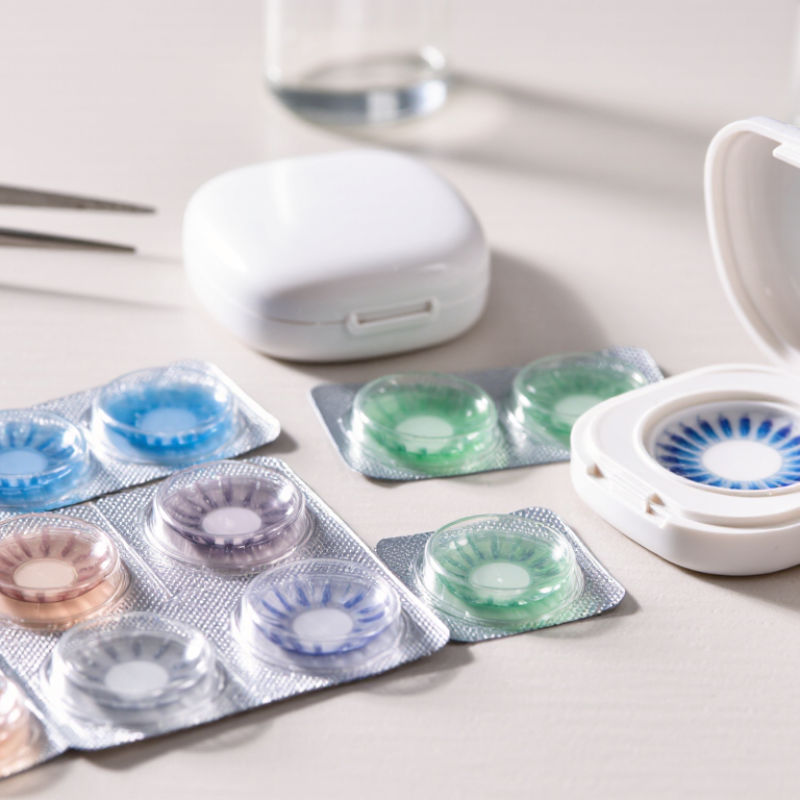
Private label colored contact lenses are lenses produced by a specialized manufacturer and sold under another company’s name. The seller usually selects the color, design, packaging, and product specifications. The factory manages production, while the private label owner manages branding, documentation, and market distribution.
The definition is simple, but responsibility is not. In the United States, the FDA classifies contact lenses as medical devices, including cosmetic lenses. They require appropriate authorization and prescription controls. The Centers for Disease Control and Prevention estimates that about 45 million Americans wear contact lenses. This figure shows a large user base, but it does not mean every colored-lens customer is properly informed.
A reliable private label program should verify material safety, optical parameters, sterility, labeling, and batch traceability. ISO 18369 provides recognized terminology and testing guidance for contact lenses. Manufacturers should also provide technical files and quality records for review. Packaging is more than appearance. It should show wearing instructions, replacement guidance, warnings, and applicable regulatory information.
The model can improve product consistency. It can also create weak points. A seller may focus too heavily on color trends and overlook fit or aftercare. That is a serious mistake. Professional review remains necessary, especially because comfort can vary between users. Industry data explains demand, but clinical evidence supports safer decisions. Sources: U.S. Food and Drug Administration, Contact Lenses; Centers for Disease Control and Prevention, Contact Lens Use; ISO 18369, Ophthalmic Optics—Contact Lenses.
Private label colored contact lenses begin with a defined product brief, not just a color idea. Developers study the target appearance, wearing schedule, lens diameter, base curve, and permitted materials. They also check local medical-device requirements before production begins.
Color specialists create digital patterns and physical samples. They place pigment within controlled lens layers, helping preserve a natural iris effect while maintaining optical clarity. Each prototype is inspected for shade consistency, edge quality, water content, power accuracy, and dimensional stability. A sample may look perfect on a screen but feel unsuitable during a professional fitting. That gap matters.
The process is not perfectly linear. Designers often revise the pattern after laboratory results or wearer feedback. Production teams then validate molds, printing accuracy, sterilization, packaging, and batch traceability. Independent testing may examine biocompatibility, microbial safety, and performance during storage. Qualified professionals should assess fit and prescription needs, because colored lenses still contact the eye directly. Manufacturing records must remain clear and verifiable. Small labeling errors can create serious confusion. Quality control therefore continues beyond the factory floor, with documented inspections and complaint monitoring. Availability and approval requirements differ by region, so responsible suppliers confirm them before selling.
A practical overview of the main design specifications, production stages, and quality-control requirements used for private-label colored contact lenses.
| Design or Production Stage | Key Dimension | Typical Industry Reference | Purpose | Quality and Safety Check |
|---|---|---|---|---|
| 1. Product Definition | Lens Type | Soft hydrogel or silicone hydrogel colored lens | Determines oxygen transmission, comfort characteristics, manufacturing method, and intended wearing schedule. | Material must be suitable for ocular use and supported by applicable biocompatibility and regulatory documentation. |
| 1. Product Definition | Replacement Schedule | Daily, two-week, monthly, or other validated schedule | Defines how long a lens may be used before replacement when worn and cared for according to the instructions. | The replacement period must match validated product performance, labeling, cleaning instructions, and regulatory requirements. |
| 2. Optical Design | Prescription Power | Commonly from plano to approximately ±6.00 diopters; broader ranges may be available | Corrects refractive errors or provides a plano option for cosmetic use. | Power is verified using calibrated optical instruments. Prescription lenses should be fitted by an eye-care professional. |
| 2. Optical Design | Base Curve | Common soft-lens values include approximately 8.4–8.8 mm | Controls how the lens aligns with the curvature of the cornea and affects movement and comfort. | Final selection depends on the wearer’s eye measurements, lens geometry, movement, centration, and fitting assessment. |
| 2. Optical Design | Overall Diameter | Often approximately 13.8–14.5 mm for cosmetic soft lenses | Determines overall coverage and contributes to lens centration and cosmetic appearance. | Diameter is measured against the approved design drawing and checked for consistency between production lots. |
| 2. Optical Design | Graphic Diameter | Commonly approximately 12.5–14.0 mm, depending on the visual effect | Defines the visible colored area and the apparent enlargement or enhancement effect. | Graphic boundaries, edge smoothness, color position, and pupil-zone alignment are inspected visually and dimensionally. |
| 3. Color Design | Color Pattern | Single-tone, two-tone, multi-tone, limbal-ring, gradient, or blended pattern | Creates the intended iris appearance while maintaining an unobstructed visual axis. | Color samples are reviewed under standardized lighting for shade, opacity, pattern registration, and lot-to-lot consistency. |
| 3. Color Design | Pupil Zone | Transparent central area sized according to the optical and cosmetic design | Allows light to pass through the center of the lens for functional vision. | The clear zone is checked for transparency, concentricity, edge quality, and adequate alignment with the pupil. |
| 3. Color Design | Colorant Placement | Colorant is normally encapsulated within the lens structure or separated from direct ocular contact | Reduces direct exposure of pigments to the eye and supports a smooth lens surface. | Surface integrity, pigment encapsulation, adhesion, extractables, and cytotoxicity are evaluated using applicable test methods. |
| 4. Mold and Tooling | Mold Geometry | Front curve, back curve, edge profile, thickness profile, and optical zone are matched to the approved design | Creates the repeatable physical form of the lens. | Mold dimensions, surface finish, alignment, and service condition are checked before production use. |
| 5. Material Preparation | Water Content | Many conventional hydrogel lenses are approximately 38%–55% water by mass; the actual value depends on the material | Influences initial hydration, lens flexibility, dehydration behavior, and oxygen transport. | Water content is tested using a validated gravimetric or equivalent method and compared with the approved specification. |
| 5. Material Preparation | Monomer and Polymer System | Medical-grade polymer system selected for the intended lens category | Provides the basic mechanical, optical, and hydration properties of the finished lens. | Raw materials are identified, batch-controlled, and assessed for purity, compatibility, and traceability. |
| 6. Lens Forming | Manufacturing Method | Common methods include cast molding, spin casting, or precision lathe production | Forms the lens body and supports repeatable control of geometry and thickness. | Critical process parameters, mold matching, polymerization conditions, and dimensional results are recorded. |
| 7. Color Application | Printing or Color Integration | Color pattern may be applied by controlled printing, multilayer molding, or another validated integration process | Transfers the approved artwork and color pattern into the lens design. | Registration, color density, pattern repeatability, surface smoothness, and pigment stability are inspected. |
| 8. Hydration and Finishing | Hydration Process | Controlled hydration in a compatible buffered saline solution | Converts the formed lens into its hydrated soft-lens state and establishes final dimensions. | Hydration time, solution quality, pH, osmolality, final dimensions, and visual clarity are monitored. |
| 9. Inspection | Physical and Optical Inspection | Diameter, base curve, power, thickness, water content, color, edge quality, and visible defects | Confirms that finished lenses conform to approved specifications. | Inspection equipment is calibrated, acceptance criteria are documented, and nonconforming lenses are segregated. |
| 9. Inspection | Bioburden and Sterility | Sterile, sealed product for the labeled wearing purpose | Protects the product from microbial contamination before opening. | Sterilization validation, routine sterility testing, package integrity testing, and environmental monitoring are required as applicable. |
| 10. Packaging and Private Labeling | Primary Packaging | Individually sealed blister or vial with solution suitable for the product | Maintains sterility, hydration, identification, and shelf stability. | Seal strength, leakage, labeling accuracy, lot coding, and expiry-date legibility are verified. |
| 10. Packaging and Private Labeling | Private-Label Artwork | Custom packaging, color names, SKU structure, instructions, and regulatory label content | Allows the purchaser to market an approved product under its own label without changing the validated lens design. | Artwork must match approved specifications and include required warnings, wearing instructions, storage information, and traceability details. |
| 11. Release and Traceability | Batch Documentation | Unique lot number, production date, expiry date, inspection records, and release status | Supports product traceability, complaint handling, recalls, and inventory control. | Each released batch is reviewed against defined acceptance criteria by authorized quality personnel. |
Important: Actual specifications vary by validated product design and applicable market regulations. Colored contact lenses, including plano lenses, are medical devices in many jurisdictions and should be fitted and supplied in accordance with local requirements.
Private label colored contact lenses are designed for a specific seller or distributor. The company may choose the lens color, packaging, wearing schedule, and product specifications. Manufacturing can still happen at an established external facility. Private label does not automatically mean higher quality. That assumption needs caution.
Generic colored lenses usually follow a standard design sold to multiple businesses. Their shade range, base curve, diameter, and packaging options may be limited. Private label products can offer more control over these details. A custom shade might appear warm brown under studio lights but look gray in daylight. Small differences matter.
The real comparison is not only visual. Check material information, oxygen permeability, water content, batch traceability, and quality testing. Packaging should show clear wearing instructions and required safety information. A qualified eye-care professional should confirm the fit, even when vision correction is not needed. Poorly fitted lenses can cause redness, discomfort, or blurred vision.
In practical product evaluation, samples should be reviewed before a large order. Ask whether the printed color matches the physical lens. It may not. Ask how defects are recorded and handled. Reliable suppliers should provide consistent documentation, not vague promises. A private label program can support better control, but only when its specifications and testing are transparent.
Private label colored contact lenses are manufactured products sold under a retailer’s own name. The brand usually selects colors, lens designs, packaging, and customer positioning. Customization can begin with natural shades, vibrant effects, or subtle limbal rings. Each choice should match the intended audience, not only a seasonal trend.
Brands can adjust graphic patterns, color opacity, lens diameter, base curve, and available vision powers. A soft brown lens may suit customers seeking an everyday appearance. A larger graphic diameter can create a more noticeable effect, but comfort must remain a priority. Packaging also shapes the experience. Clear instructions, batch details, expiry information, and suitable storage guidance support customer trust.
Professional development requires more than attractive sample photos. Experienced manufacturers should provide material specifications, quality records, and documented testing. Local regulations may classify contact lenses as medical devices, even when they have no vision correction. Brands must verify approval, labeling, and prescription requirements before selling them. Customer feedback is useful, but it is not a substitute for clinical expertise.
Some designs look different in real life. Lighting changes perceived color. Digital previews can mislead. A responsible team should test samples on diverse eye colors and review comfort with qualified eye-care professionals. This process may reveal that a beautiful pattern feels too strong, or that a popular diameter does not suit every wearer. That is an inconvenient lesson, but it improves the final product.
Private label colored contact lenses are products manufactured by one company and sold under another company’s name. The arrangement may appear simple, but safety and compliance cannot be treated as packaging details. In many markets, contact lenses are regulated medical devices, even when they are promoted for cosmetic use. Requirements may include product registration, prescription controls, approved labeling, and traceable distribution records.
Before launch, identify the legal manufacturer and define responsibilities in writing. Review the manufacturing site, quality system, material specifications, and batch testing records. Important checks include base curve, diameter, oxygen permeability, water content, pigment placement, sterility, and packaging integrity. Pigment should remain safely enclosed within the lens material. A damaged blister, unclear expiry date, or missing lot number is a serious warning. Local regulations differ, so qualified regulatory advice remains necessary.
Tips: Request independent test reports, not only supplier assurances. Check samples after storage and transport simulation. Confirm that customer complaints and adverse events have a documented response process. Avoid exaggerated claims about comfort, safety, or wearing time. Small details matter.
Quality evaluation is not a one-time inspection. It should continue through production, shipment, and post-market monitoring. An attractive sample may hide inconsistent edges or unstable color performance. That is an uncomfortable lesson. Private label success depends on evidence, transparent records, and the willingness to delay launch when something feels uncertain.
They are lenses designed for one seller or distributor. The seller may choose colors, packaging, diameter, base curve, and wearing schedule. Production can occur at an external facility. Private label does not guarantee better quality.
Developers create digital patterns and physical samples. Pigment is placed within controlled lens layers. This supports a natural iris appearance and optical clarity. A screen preview can mislead.
They should define color, lens diameter, base curve, material, and wearing schedule. They should also check local medical-device requirements. Prescription power may be included when appropriate. Small details matter.
Samples are checked for shade consistency, edge quality, water content, and power accuracy. Teams also inspect dimensional stability and printing accuracy. A professional fitting can reveal problems missed in a laboratory. That gap matters.
Yes, a printed color may differ from its screen image. Warm brown can appear gray under different lighting. Review physical samples before placing a large order. It may surprise you.
Generic lenses usually follow standard designs sold to several businesses. Private label products can offer more control over color and packaging. Their quality still depends on materials, testing, and documentation. Customization alone proves little.
Buyers should check material details, oxygen permeability, water content, and batch traceability. Packaging should include wearing instructions and required safety information. A qualified eye-care professional should assess fit and prescription needs. Even cosmetic lenses touch the eye.
Production teams validate molds, sterilization, packaging, and printed details. Independent testing may examine biocompatibility, microbial safety, and storage performance. Complaint records and inspections should remain documented. Labeling mistakes can create confusion.
Approval and availability rules differ between regions. Responsible suppliers confirm requirements before selling. Records should be clear, current, and verifiable. Assumptions can fail.
Private Label Colored Contact Lenses are cosmetic or vision-correction lenses developed by a manufacturer and sold under another company’s own brand identity. This model allows businesses to create a distinctive product line without managing every stage of lens production themselves. From initial concept to final packaging, the process may include selecting lens materials, color effects, dimensions, wearing schedules, packaging styles, and labeling that align with the brand’s target customers and market positioning.
Unlike generic colored lenses, private label products offer greater control over appearance, presentation, and customer experience. Brands can request customized shades, patterns, packaging, and product information while working with qualified manufacturers. Before launching, however, businesses should carefully evaluate material quality, manufacturing consistency, comfort, prescription accuracy where applicable, packaging integrity, and required regulatory documentation. Proper testing, transparent labeling, professional quality control, and compliance with relevant safety standards are essential to protect users and build long-term trust.